Daejeon & Okcheon for Lunar New Year: Walk, Eat, Repeat
Seollal (설날) — the Korean Lunar New Year — clears out the cities and fills the roads. We headed to Daejeon (대전), a major hub in central South Korea roughly 1.5 hours south of Seoul by KTX, with family in tow. One errand, two days, one very simple itinerary: find a quiet trail, eat well, repeat.
Okcheon (옥천), a small town about 30 minutes south of Daejeon, made it into day two for one reason: jjolmyeon noodles at Pungmidang. But more on that shortly.
Day 1: Seongbuk-dong Forest Bathing Area (성북동 산림욕장)
Daejeon has bigger, more famous forest spots — Jangtaesan (장태산) and Manisan (만인산) both draw steady weekend crowds. Seongbuk-dong Sanlimyokjang (성북동 산림욕장, "forest bathing area") does not.
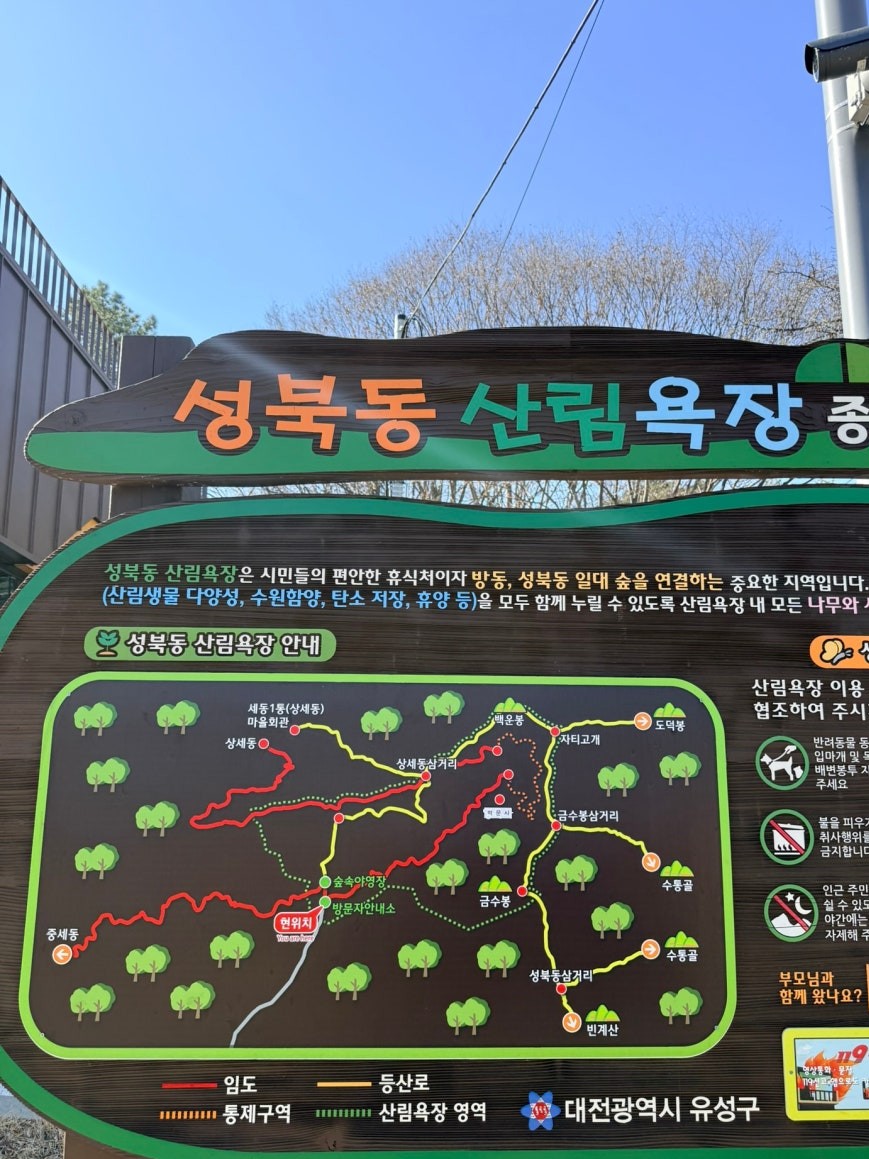
The path from the entrance is consistently gentle. No scrambling, no steps cut into rock. The full loop takes about an hour at a casual pace, and the whole family managed it without complaint. Entry and parking are both free.
Even on a Lunar New Year holiday — when parking anywhere becomes a competition — the lot was half empty when we arrived.
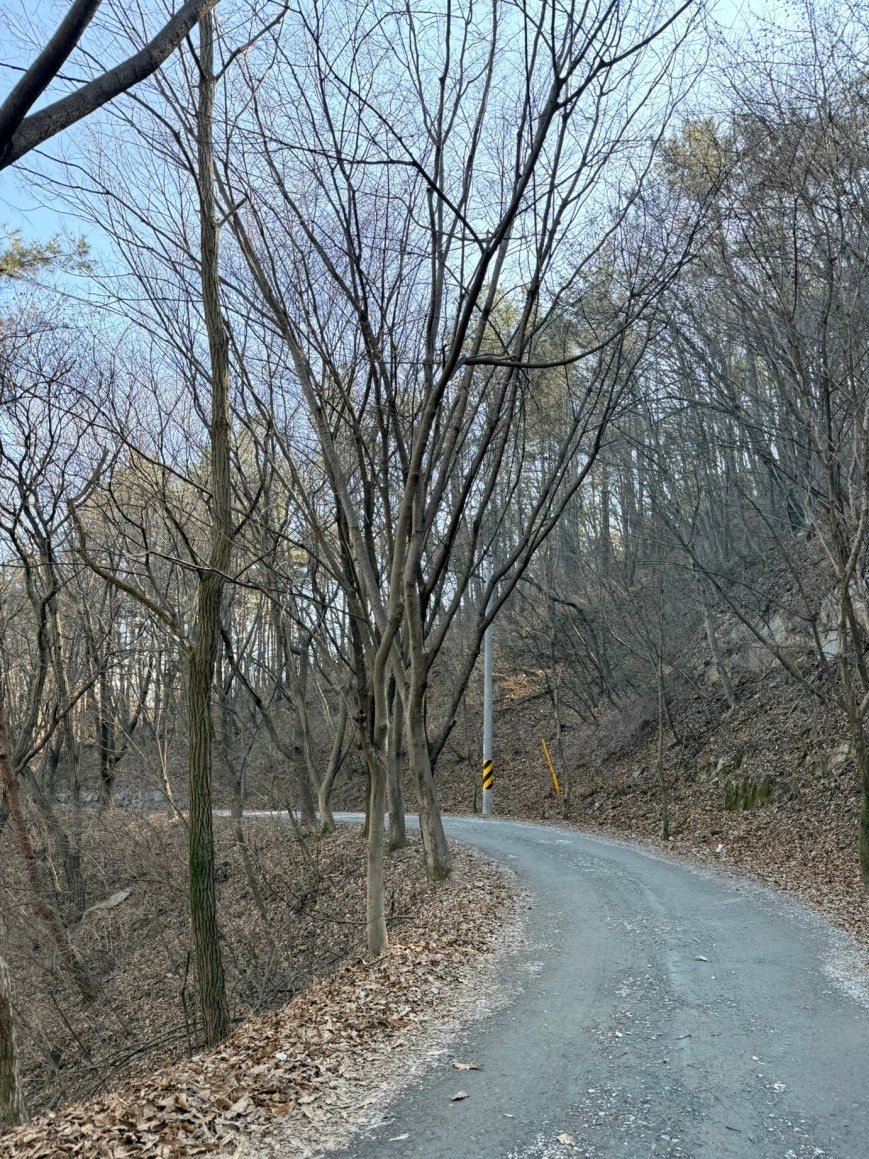
The trail is maintained but doesn’t feel over-engineered. Quiet enough that you catch birdsong and the sound of running water. Trail runners and mountain bikers passed us a few times — the kind of path that serves a range of people without being claimed by any of them.
Tip: Bangdong Reservoir (방동저수지) is a short drive away. Easy to pair into a half-day without backtracking.
Day 1 Evening: Saeng-Daepae Open-Run
My parents have a regular spot. A grilled pork restaurant specializing in saeng-daepae (생대패) — fresh, never-frozen thinly shaved pork belly. Opens at 5 p.m. Arrive late and there are no seats. We arrived at 5.
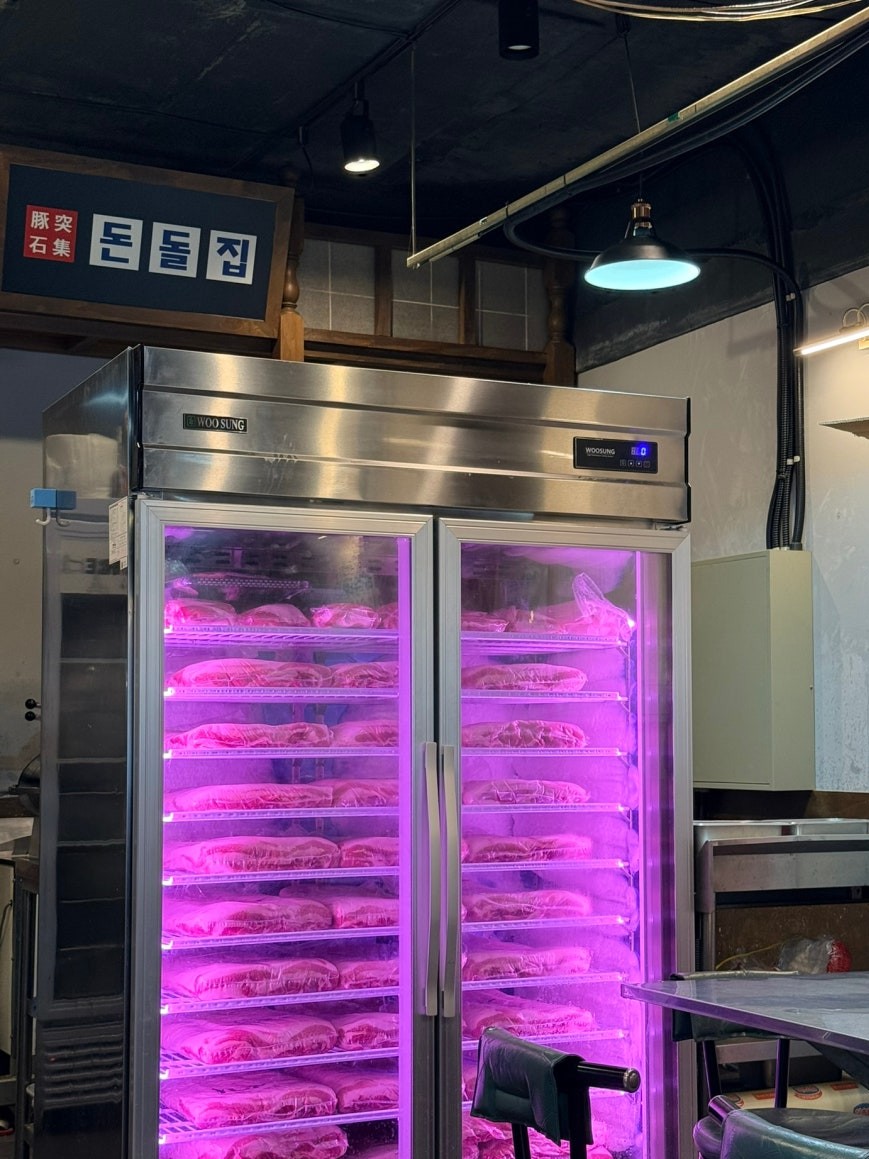
Saeng-daepae is distinct from the standard version at most Korean BBQ spots — the meat has never been frozen, so it cooks faster and the texture holds differently on the grill. I hadn’t tried it before this trip.
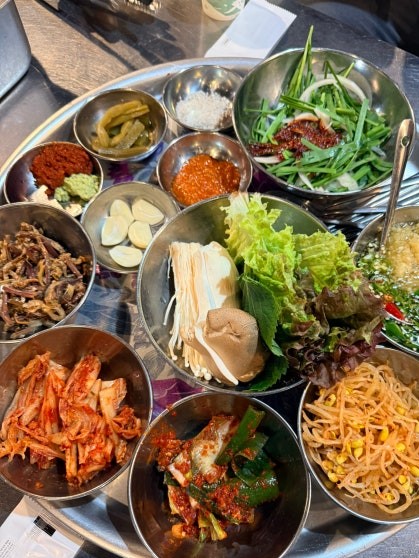
Side dishes came out across a full tray. The dipping sauce — garlic, chili, something else that keeps you reaching back — was built specifically for this cut. Not salty. Not heavy. Just enough to keep ordering more meat.
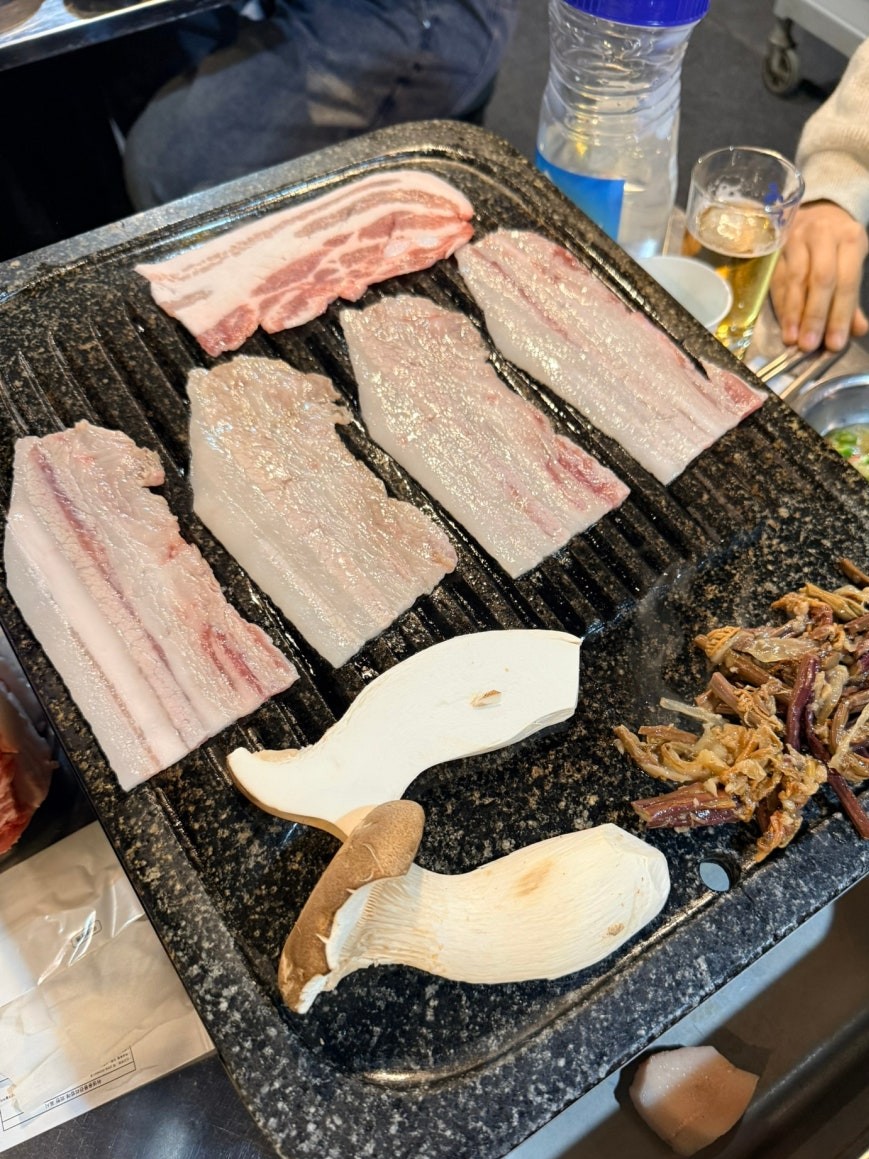
Fresh pork cooks fast. No long waits between rounds.
The meal finished with cheonggukjang (청국장 — a deeply fermented Korean soybean paste stew, pungent and warming) and fried rice. Strong flavors, exactly right after all that grilling.
Day 2 Morning: Pungmidang (풍미당), Okcheon
Okcheon (옥천) is about 30 minutes south of Daejeon. One of the main draws is Pungmidang (풍미당) — a jjolmyeon restaurant that’s been here long enough to paper its walls with television appearance certificates.
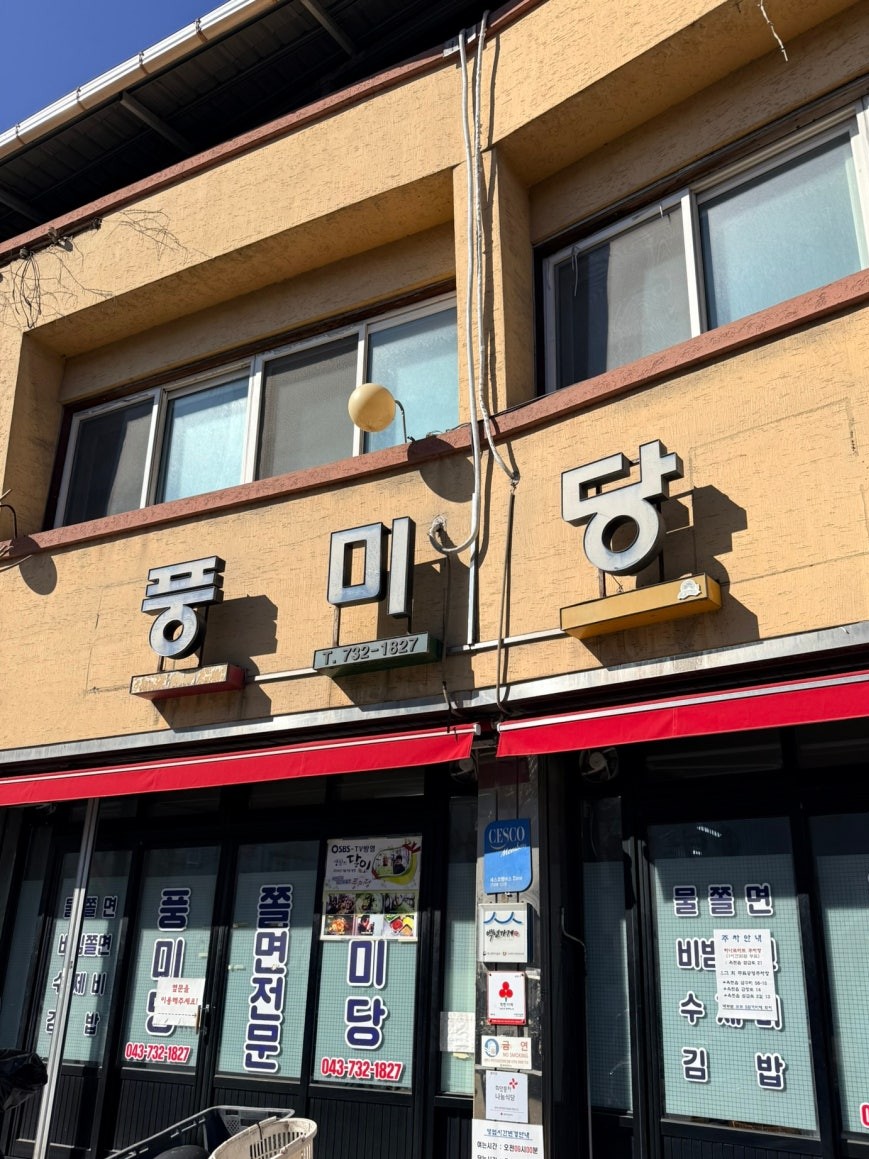
The building has that unmistakable local institution look — sandy yellow walls, blocky signage, the kind of storefront you might walk past assuming it’s a bakery. Inside, the seating has switched from floor-style to regular tables sometime in the past few years, but the framed TV clippings covering every wall stay the same.
Parking: The road in front is actively enforced. Best option: Hanaro Mart (하나로마트) parking lot — 90 minutes free, closest to the restaurant. Public lots are within a 5-minute walk. Roadside enforcement applies on weekdays and Saturdays, with an exemption during lunch hours (11:30–13:30) and on public holidays.
The menu is short, listed on a wall board:
| Item | Regular (보) | Large (곱) |
|---|---|---|
| Mul-jjolmyeon (물쫄면) | ₩8,000 | ₩9,000 |
| Bibim-jjolmyeon (비빔쫄면) | ₩8,000 | ₩9,000 |
| Sujebi (수제비, hand-torn noodle soup) | ₩8,000 | ₩9,000 |
| Kimbap (김밥, one roll) | ₩3,000 | — |
Jjolmyeon (쫄면) is a thick, springy Korean noodle — considerably chewier than regular cold noodles. Mul-jjolmyeon (물쫄면) is the version served in a cold broth; bibim-jjolmyeon (비빔쫄면) is the dry, sauce-tossed version.
The menu board carries one firm instruction:
"풍미당 별미는 물쫄면입니다." — The house specialty is mul-jjolmyeon.
Followed immediately by a warning, complete with a large crossed-out scissors illustration:
"물쫄면은 잘라드시면 맛없습니다! 안돼요!" — Do not cut the noodles. It ruins them.
They mean it.

We ordered one mul-jjolmyeon, one bibim-jjolmyeon, and a roll of kimbap. The kimbap was ordinary. The bibim-jjolmyeon was fine — exactly as expected. The mul-jjolmyeon was the point of the trip. Tangy, lightly spicy cold broth, chewy noodles in long strands. No scissors.
Order two mul-jjolmyeon if there are two of you.
Day 2 Afternoon: Gapcheon Eco Lake Park (갑천 생태호수공원)
An hour’s drive back toward Daejeon: Gapcheon Eco Lake Park (갑천 생태호수공원), a recently developed artificial lake along the Gapcheon stream in western Daejeon.
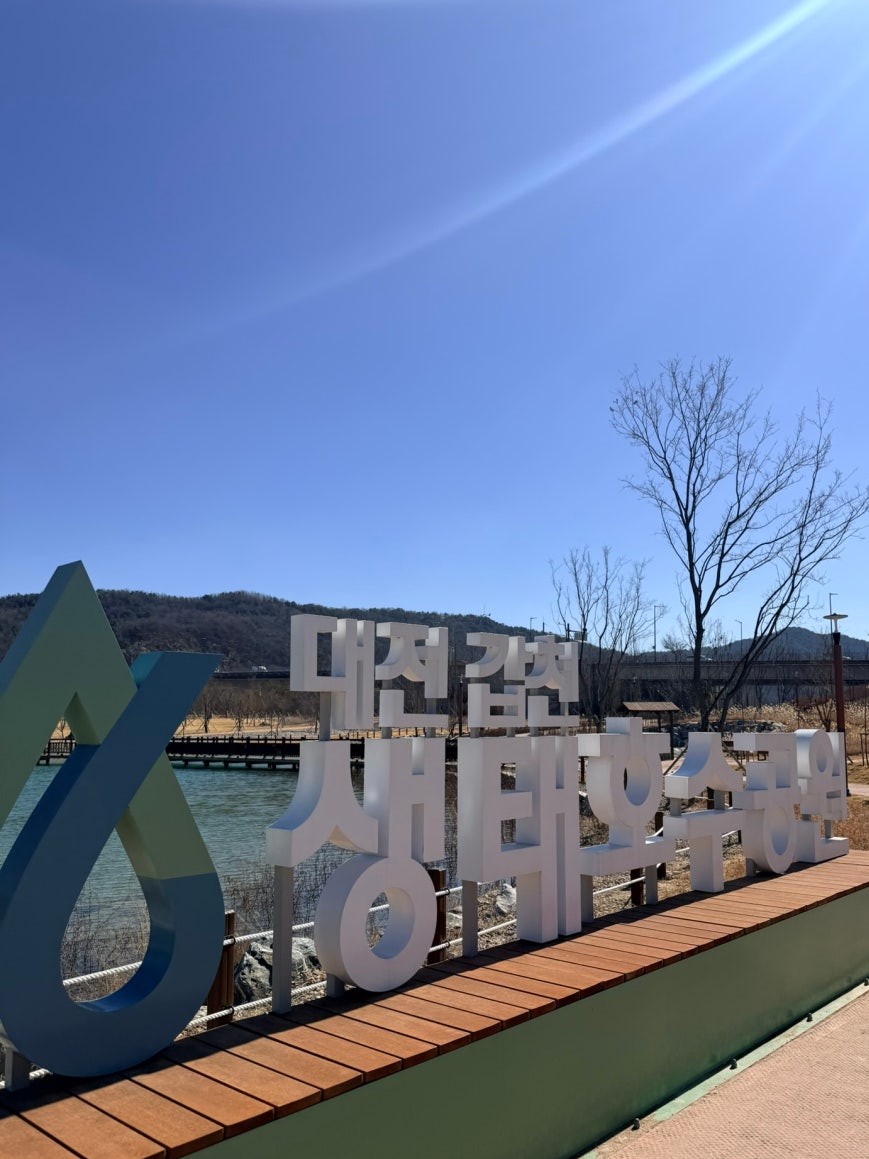
Parking: Three lots — A, B, and C. Lot A sits higher up the hill; reaching the main lake from there means a longer walk down. If the lake is your goal, use B or C. Lot C is the largest of the three.
The water runs an unexpected clear turquoise. The park is clean and well laid out — newer infrastructure, nothing weathered yet. We came in with low expectations and left impressed.

Sunlight hit the water at just the right angle that afternoon — what Koreans call 윤슬 (yunsseul, the shimmer of sunlight on rippling water). Clear winter light, still surface. Worth the drive for that alone.
On the far end of the main lake: a spiral observation tower and a suspension bridge.
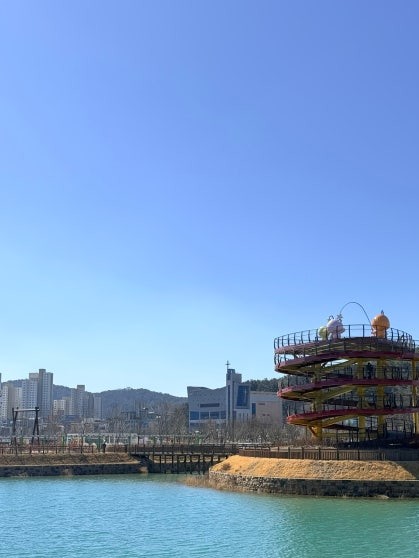
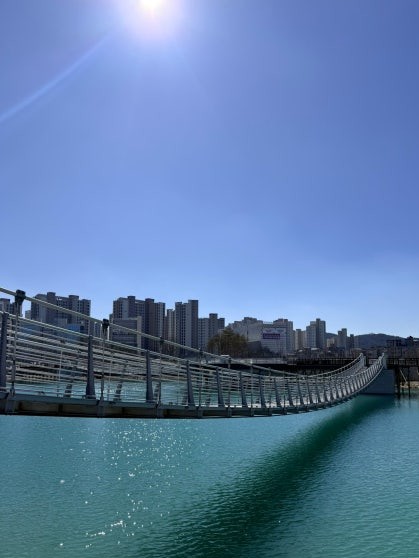
The bridge sways underfoot. The tower puts the full park and city skyline in view. Neither was crowded on a Lunar New Year weekday — which felt like a small bonus neither of us planned for.
Aerial cycle rides (공중 자전거 — bikes suspended on an overhead track) run along one section of the park. We got on them. Come on weekends and you’ll probably queue.
Wrapping Up
Closed out the day at a board game café. Nintendo consoles on offer — we played It Takes Two, a co-op game that’s objectively better with someone you actually want to cooperate with.
Two days, central Korea. Forest trail, open-run BBQ, local noodles, a lake you didn’t know existed. Walk, eat, done.
If you’ve made it to Daejeon or Okcheon and have a spot you keep returning to, drop it in the comments — always building the next list.